
Triangle Field is keeping me up at night

Sometimes at this time of year, as the days romp towards the longest, I find it hard to draw the line of the day. The neverending daylight means that outdoor jobs - and there are plenty of them - can be accomplished post 9.30pm. During June, we always end up working long days and I wonder why we don’t get more tired; there’s something about the sunshine and the peace of having no children around that revitalises the soul and gives us both an energy boost. In fact, working from 7.30 - 10pm in summer are some of our most productive times. It’s such a beautiful time of year, you don’t want to sleep to miss any of it.
Today, we cut the grass in our field orchard and we spent the day raking and making traditional hay stacks. It’s labour intensive and hard work, especially in the heat (and the fact that our orchard is steeply sloping is a complication), but once you submit to the effort and physical exertion, you can have a nice (if painful) time, mindlessly raking, carrying and traipsing back up the hill. I’m always amazed at how heavy freshly cut long grass is and spent some time thinking what a good all-body workout it was and no wonder Victorian farmers were so fit and strong. Adam tells me that the Brownlee Brothers used to ‘enjoy the pain’ of doing triathalons and encouraged me to do the same. I was quite hot and bothered at one point and remarked that I think if Mr Brownlee or his brother, had the great privilege of having their bodies re-wired by a quartet of 42 week pregancies, they might have lost a bit of core strength too - perhaps they might not have enjoyed the challenge quite so much either!
I then got to thinking about biology, sex and gender. A complex pit of worms that I won’t go in to here. Suffice to say, biology played a big role in what we did today and who was the best at the job. Adam was in his element, I think it might have been born 300 years too late, fitting perfectly the temperament and physique of a rural estate worker in the 18th century who spends all his days on manual labour. I found it quite arduous and although I completed the day and now feel fine, I have not enjoyed the blisters on my hands!
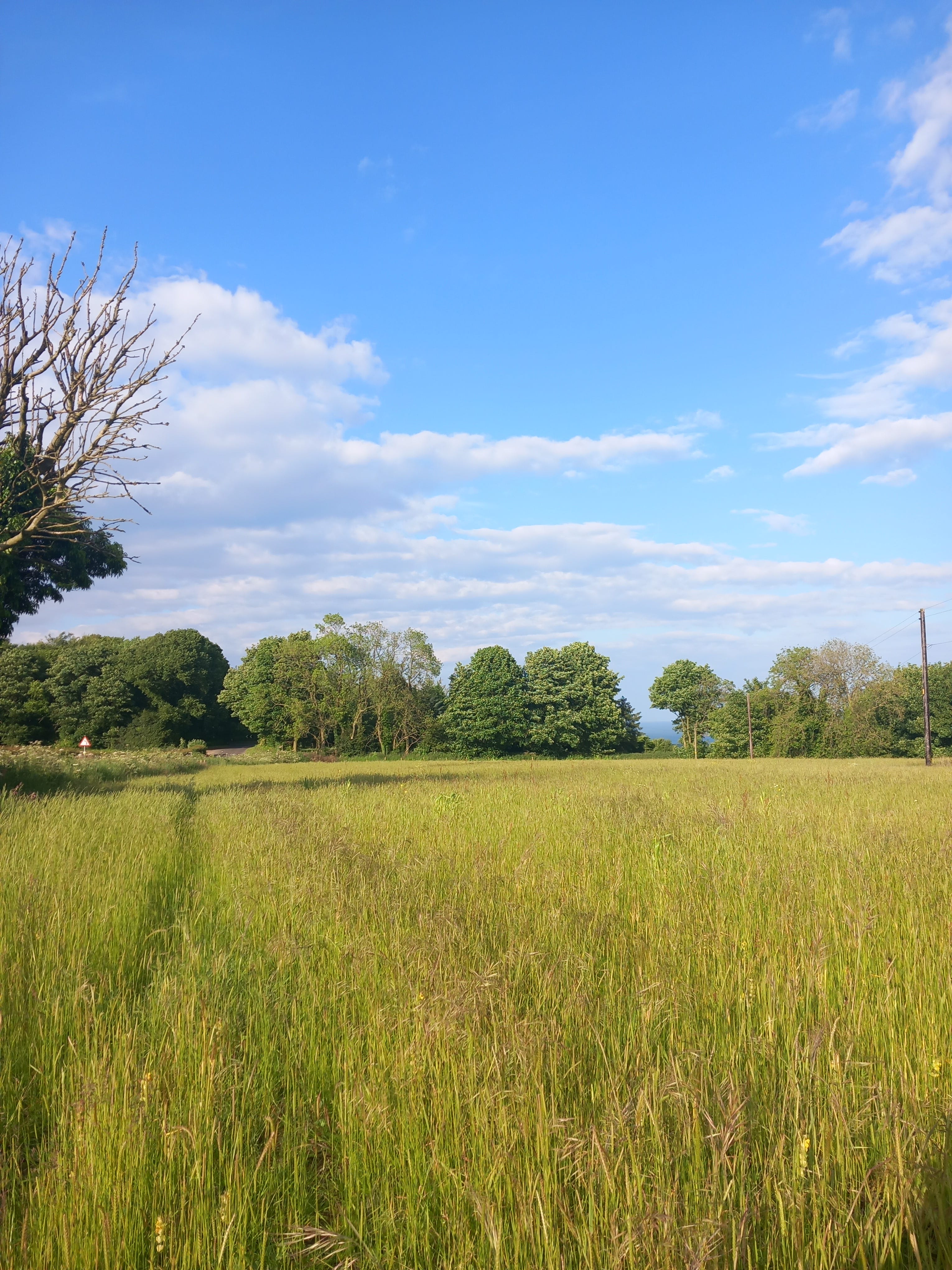
Anyway, speaking of grass, our endeavour to turn Triangle Field in to 5 acres of species-rich grassland is bearing fruit. Well, flowers. A quick recap… Before sowing in October 2023, we tested the soil for phosophorus which fortunately indicated that the fertility level was low. This was quite a surprise; for as long as we have known, the land was used for barley and this is conventionally fertilised quite heavily. Luckily the previous owner had not the time to fertilise last year and this has really helped us. The barley crop actually depleted the fertility in the soil, being as it is, a hungry crop, thus preparing the ground perfectly for a hay meadow. It’s essential to have low-fertility soil to establish a good meadow, rich soil just benefits the viorous grasses and the flowers and native grasses can’t compete.
Armed with positive test results, we went ahead and harrowed the field, sowed the meadow mixture by broadcasting (we contracted a farmer neighbour to do this) and rolled the seed in. We had the great fortune of a warmish and damp spell which helped the seed to settle in and germinate. The mixture we have used contains a huge mix of flowers and grasses, once common on un-improved low-land meadows. Many of the species are perrenial and will be slow to establish, flowering only in the second year. This is a slow process and we will need to be patient. (Adam is patient of course. I am not, but I’m learning.) The following species are all present in the seed mix and we can identify almost all of these, even if they are only showing foliage at the moment, not flowers. The yellow rattle appears to be in great quantity and is all flowering and setting seed, which should help us next year with the development of the meadow. Many will know by now that yellow rattle is parasitic on grass roots, so it’s very helpful in hindering the growth of the vigourous species, in favour of the wild flowers.
Wild Flowers – 20%
0.60% Achillea Millefolium – Yarrow
0.80% Agrimonia eupatoria – Agrimony
0.40% Betonica officinalis – Betony
3.00% Centaurea nigra – Common Knapweed
0.60% Daucus carota – Wild Carrot
1.60% Galium verum – Lady’s Bedstraw
1.60% Knautia arvensis – Field Scabious
0.10% Leontodon hispidus – Rough Hawkbit
2.00% Leucanthemum vulgare – Oxeye Daisy
0.20% Lotus corniculatus – Birdsfoot Trefoil
2.40% Malva moschata – Musk Mallow
2.60% Plantago lanceolata – Ribwort Plantain
1.20% Poterium sanguisorba – Salad Burnet
0.80% Primula versis – Cowslip
0.20% Ranunculus acris – Meadow Buttercup
0.10% Ranunculus bulbosus – Bulbous Buttercup
1.00% Rumex acetosa – Common Sorrel
0.40% Silene vulgaris – Bladder Campion
0.40% Vicia cracca – Tufted Vetch
Grasses – 80%
1.60% Anthoxanthum odoratum – Sweet Vernal-grass (w)
3.20% Briza media – Quaking Grass (w)
56.00% Cynosurus cristatus – Crested Dogstail
10.40% Festuca rubra – Red Fescue
8.00% Agrostis capillaris – Common Bent
0.80% Trisetum flavescens – Yellow Oat-grass (w)


A rather curious phenomena is that there are also a lot of cornflowers and field poppies flowering, which were not in the seed mix. Their seed is very long lasting, so it would not be impossible to imagine that the seeds have been in the ground for decades and this is the first time that it has had a chance to flower. Quite remarkable that as far as I know, this is the only hay meadow in Suffield, a village which would once have had many small meadows, now of course all replaced with modern silage fields or large multi-hectare fields of arable crops.
Sadly, Suffield is no different to any other place in the UK by having no/very few hay meadows. Across the country, over 97 per cent of the UK’s hay meadows have vanished since 1930, decreasing from more than three million hectares to less than around 12,000 remaining today, according to a survey by conservation charity Plantlife. This was not done as an act of malice, we must remember that initially, the increase in food demand during World War II led to many traditional hay meadows being replanted with fast-growing grass species or ploughed up for other crops. Neverless, this had a huge impact on the biodiversity of these habitats and the problem has been compounded by modern agricultural practices which focus on high-yield crops and fodder for the meat & dairy trade.
Even now, when we are aware of the biodiversity crisis in our country, species-rich grasslands are still being ‘improved’ by being oversown with fast-growing perennial rye grass and white clover which outcompete any of the existing flora. Artificial fertilisers are commonly applied (contributing to the nitrogen crisis in our waterways) to create rich, fast growth, all at the detriment of native wildflowers and grasses. The grass is usually cut in late May when the meadow species have not had chance to flower, let alone set seed, so you can see that within a season or two, their populations can be wiped out. A second cut of silage is often taken in July following the application of more fertilizer and this has further devastated impacts on the ground nesting bird populations whose nesting habitat is destroyed. We drove to Roseberry Topping in the half term and saw vast fields of the uplands being cut for silage, all the while noticing lonesome lapwings and curlews flying over the fields- probably wondering where their nests and eggs have gone. As a ground-nesting bird, if a sheep doesn’t get you, a mower will.
Traditional hay meadows certainly don’t fit in the model of modern agriculture and our collective obsession with creating cheaper food has driven the intensification of farming. The destruction of habitat and reduction in biodiversity is a direct consequence of these ‘developments.’
I said this before in my post about silage, but it’s worth repeating again, because I think that when people see fields of rich green grass (a monoculture, with no diversity), there is sometimes a misunderstanding that these fields are not linked to meat or dairy production. Don’t be mistaken, these fields are as much a part of the meat and dairy industry as animals themselves – the grass is cut, baled and wrapped, then fed to the livestock as silage in the winter. Modern mechanisation and the availability of plastic wrapping has allowed silage-making to replace hay-making. For many reasons, you can see what silage making is more popular: silage is more nutritious than hay and if you have an intensively-milked dairy herd, then you need rich food for them. The grass can be cut earlier (meaning that more than one cut can be taken in a season) and it does not need drying, conveniently avoiding the need for several consecutive days of dry weather and let’s face it, no-one can depend on a dry summer in today’s climate. Unfortunately, silage making requires greater investment in expensive machinery, which in turn requires greater returns, which are usually obtained through the use of artificial fertilisers.
I’m not blaming farmers, they’re at the rough end of a warped and corrupted food system, which is no longer local or seasonal and consumers are so removed from the food they purchase and eat. It’s just a rather bleak and seeminly neverending cycle of supply & demand. I’m not an expert, but I know that money talks, so I would imagine that to encourage farmers to re-establish hay meadows in their farms, would require a big investment to financially incentivise the actions.
Here at least, we are making small steps to bring back the traditional hay meadow back to Suffield, even 5 acres will make a difference to the biodiversity of the area and we are very excited to see how things progress over summer and in to the next year. And that’s we’re doing this: it’s because we believe it’s the right thing to do for our ecosystem and the environment. But, we’re also doing this because hay meadows are beautiful, magical places. They evoke so much and remind us of a time past when life was simpler, more basic, lived in tune with the rhythyms of nature and the seasons. It’s a project for nature, yes, but it’s a project for love too. Love and romance. What better way to celebrate ten years of marriage, than with a meadow. Forget about tin, I say yellow rattle would be more apt for us.
Practically speaking, we will be cutting the hay later in the summer and after leaving the grass in situ for the seeds to disperse, we will be baling and selling our first crop of wildflower hay. Following the harvest, we will need to employ the help of some four-legged friends to graze the re-growth for us, to ensure that the meadow is successful the following year. Sheep will be our favoured animals, they’ll keep down the vigorous grass growth and make little divets in the ground which will enable germination of seed. The sheep will only graze the area lightly and then move on to our other fields and we’ll rotate them from site to site, until the cycle begins again next year.
Next year, next year… Growing is always about looking ahead, planning a harvest, another planting, another sowing. Sometimes we don’t stop to look and see the moment right now; it isn’t quite dark outside, so I’ll walk for a few minutes in the meadow before bed; take some time to watch the bats, listen to the owl in the sycamore and remember my children playing in the long grass after school, spotting voles, flowers and even a nesting duck.
I know now why I’m not tired in June, it’s because these things, these insignificant things are uplifting and thrilling. The most unexpected and joyous things to come from a project like this, are these happy memories that spring from nowhere like the field poppies.
I hope that when I am old enough to be tired in June and the oaks we have planted are too big to wrap my arms around, that I can close my eyes and walk through my carefully curated memories; see the swathes of crested dog’s tail and cornflowers, hear the skylark and cunjour the same sensation. Perhaps that is the greatest power of the hay meadow; the power to transport you to a time of yesteryear.
Thank you Ruby, that is a beautiful piece of writing. I was right there with you in the meadow, walking through on a June evening. Beautiful, thanks to you and Adam for making a difference.
Thanks to you too Paul for sharing the Knepp film, what an inspiration there too.